

Railways in
Jersey
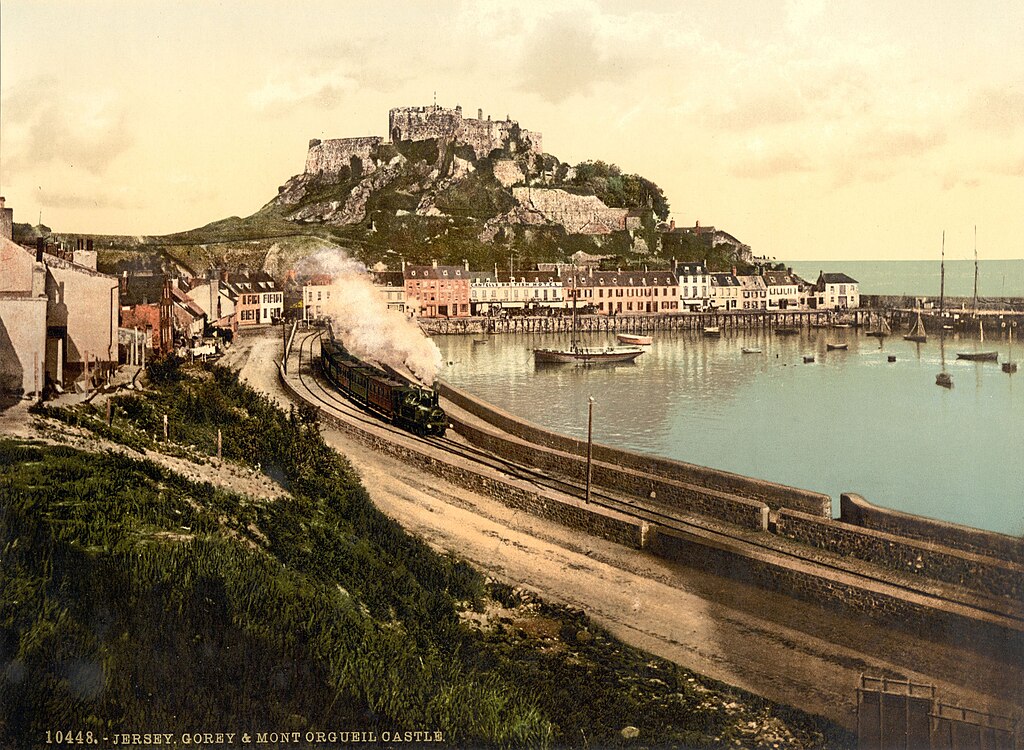
The Jersey Eastern Railway at Gorey
Jersey is one of the Channel Islands. Together with a number of small, mainly uninhabited islands, it forms the Bailiwick of Jersey which is a British Crown Dependency.
The Jersey railway opened in 1870 as a standard (4ft 8½in, 1435mm) gauge line from the capital, St Helier, to St Aubin. Another company started construction on a 3ft 6in (1067mm) gauge line from St Aubin to La Moye, but went bankrupt before its completion. The unfinished line was taken over by the original company, which converted its line to 3ft 6in (1067mm) gauge in order to provide a through route from St Helier to La Moye. The combined line was later extended to Corbière, giving a total route length of 8½ miles (13.7km). The line closed in 1926.
A separate standard gauge line, the Jersey Eastern Railway, opened in 1873 between St Helier and Grouville, later extended to Gorey, a total route length of 6¾ miles (10.8km). It closed in 1929.
During World War II, the occupying German forces laid down a number railways of 600mm and metre gauge for military purposes. These utilised in part the trackbeds of both of the closed railways. These military lines were dismantled after the liberation.
Several of the stations of the original lines survive as public buildings. Various sections of the former trackbeds are now footpaths.
In the 1990, the Pallot Steam, Motor & General Museum opened in Trinity parish, with a 500 yard (450m) standard gauge railway in its grounds. It was equipped with historic steam and diesel locomotives and passenger rolling stock from various sources in the UK mainland. There was also a 380 yard (350m) narrow gauge railway, operated by a steam outline diesel locomotive. However, both railways were out of action by 2025, with no stated plans for reopening.
© 2019-2025 Glyn Williams
Image from Views of England in the Photochrom print collection,
USA Library of Congress