
Railways in
Guinea
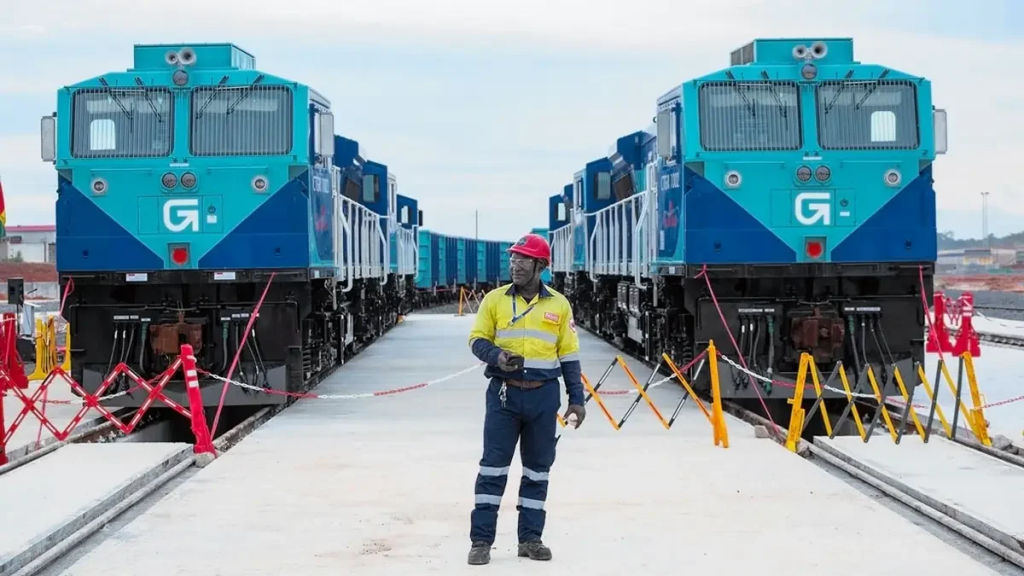
Locomotives of la Compagnie du TransGuinéen newly delivered at the Port of Morébaya in 2025
CTGR 1001 to 1004 are ES43ACi 4500hp Co-Co diesel electrics built in India by Wabtec
The first railway in French Guinea opened in 1902 between Tombo and Kaloum. It was built to metre gauge, then in common use for minor railways in France. The following year, the line was extended to the capital city and port of Conakry, and by 1913 as far as Kankan (albeit with two breaks at major river crossings). This public 662km line remained the only railway for many years, but the greater part of it had closed by the 1980s.
In 1963, a new 143km metre gauge railway opened between Conakry and bauxite mines at Fria. In 2003 operation was acquired by Russian corporation Rusal. By 2012, production was flagging and the mines closed. Following government intervention, the mines and railway reopened in 2018, but finally closed in 2021 following a military coup.
In 1973, a new standard (1435mm) gauge railway, the Chemin de Fer de Boké, opened for the conveyance of bauxite from the mines at Sangaredi to the port of Kamsar, a distance of 136km. A daily passenger service also operates.
In 2001, a new 105km standard (1435mm) gauge railway, roughly following the route of the original metre gauge railway, was opened by the Compagnie des bauxites de Kindia, connecting its mines at Kindia with the port at Conakry. In 2001, the company became part of Russian corporation Rusal. A passenger commuter service, the Conakry Express, was launched in 2011, operating on the first 36km of the line. Following the Russian invasion of Ukraine in 2022, operations were tranferred to the Compagnie des Bauxites de Guinée.
In 2014, a new 900km railway was proposed from Conakry to Bamako in Mali. Although no progress has been made to date, it continues to feature in governmental plans.
In 2019, Guinea Alumina Corporation opened a short railway connecting its mines at Tanènè with the CF de Boké, over which it carried bauxite to its port facility in Kamsar. GAC’s license was revoked in 2025; operations resumed in 2026 under the government owned Nimba Mining Company.
In 2021, a new 125km standard gauge railway opened, linking developing bauxite mines in the Santou and Houda areas with an alumina refinery and port facility at Dapilon.
In 2025, a new 600km standard gauge railway was completed, from iron ore mines in the Simandou area to a new deep water port near Morébaya.
Also in 2025, the Liberian government gave Ivanhoe Atlantic rights of access to the Buchanan to Yekepa railway, with the object of providing an export route for iron ore from the Kom Kweni mines in Guinea. This will permit the construction of a new railway in Guinea to connect with the existing railway in Liberia.
In late 2025, the Minister for Transport announced that funding would be available in 2026 for a study into a 25km tram line between Kaloum and Matoto in the Greater Conakry area.
© 2006-2026 Glyn Williams
Photo image: SimFer