
Railways in
Bougainville
This autonomous region of Papua New Guinea is expected to achieve full independence around 2027
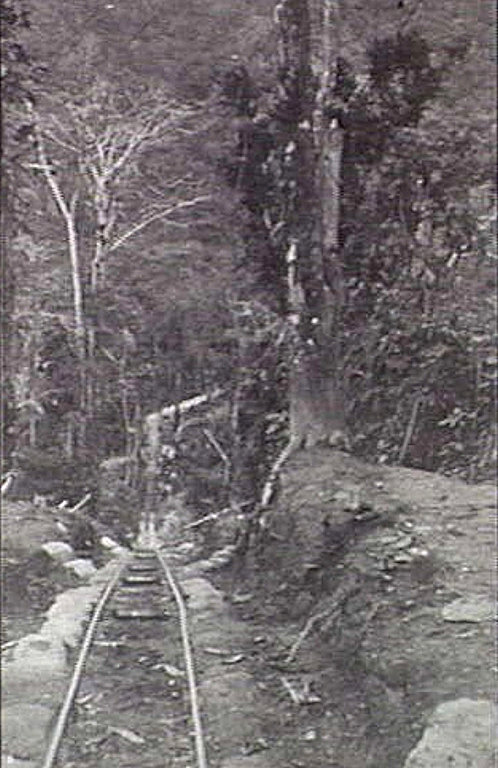
A steep cable hauled railway built in 1943 by Australian troops at Barges Hill.
This autonomous region of Papua New Guinea is expected to achieve full independence around 2027
The first railways on Bougainville appeared in the 1920s, when the island was administered by Australia, under League of Nations mandate. These were tramways serving the numerous Copra and Cacao plantations, and were predominantly 2 foot (610 mm) gauge, using wagons propelled by hand. The most extensive system was at Soraken, with a total length of some 14 miles (22 km). Nearly all the tramways were destroyed during World War II, or recovered for scrap soon afterwards.
During the Japanese occupation in 1942, a number of tramways were built to facilitate construction of the various airfields on the island. These were 2 foot (610 mm) gauge, in many cases using track and equipment recovered from plantations. A slightly heavier 2 foot gauge line was constructed from Buin Port (now Kangu Beach) to Kara airstrip (now the settlemen of Buin), a distance of about 8 miles (13 km), for the transport of supplies. Uniquely, it was locomotive hauled, 7 locomotives being provided. All of these lines languished after the war.
As part of the recovery of the island by Australian forces, in 1943 troops of the 23rd Field Company Australian Engineers constructed a railway to allow supplies to be carried up the steep slope of Barges Hill. 2 foot (610 mm) gauge, cable hauled, it ascended 894 feet (272 m) in a distance of 2245 ft (684m), with a maximum gradient of 1 in 1 (100%, or 45 degrees).
In the early 1950s, plantation tramways were reinstated at Boau, Kunua, Soraken, and Tinputz. Diesel locomotives were imported for the Kunua and Soraken operations in 1977. All the lines had become disused by the mid 1980s.
During the 1950s, short 2 foot (610 mm) gauge tramways were constructed to connect mission premises at Asitavi, Kieta, and Skotlan with their respective wharfs. Again, all these were disused by the mid 1980s.
In the 1960s, exploratory drilling took place in the area of the Panguna copper deposits. This operation was supported by tramways. In 1977, work commenced on a new mine in the area. A 900 mm gauge railway, mostly underground, was used in the construction of its 7km drainage tunnel. Locomotives were a mix of diesel and battery electric. The line was dismantled following completion of the tunnel.
At some time in the 1980s, a locomotive and several wagons from the Buin railway were restored and transported to Kieta, where it was planned to create a short, operational, museum railway. The project was abandoned with the outbreak of civil war in 1989, and it is not known what happened to the equipment.
No operational railways remain today.
© 2025-2026 Glyn Williams
Photo image Australian War Memorial P00650.004